EXECUTIVE SUMMARY
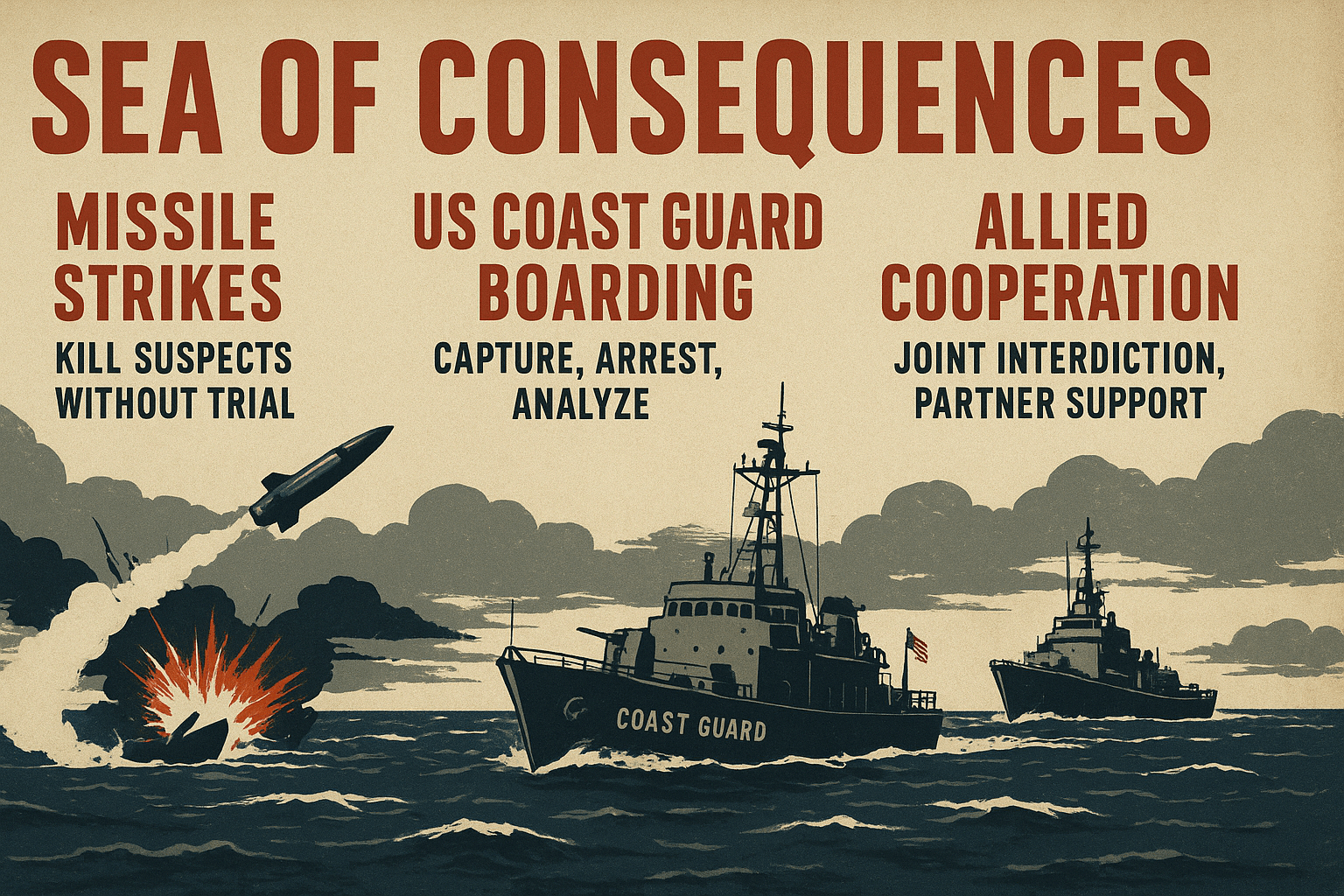
In 2025, U.S. policy and operations shifted in troubling ways: a string of kinetic strikes on suspected drug-smuggling vessels replaced, in several reported cases, the longstanding law-enforcement approach led by the U.S. Coast Guard. The public record and investigative reporting indicate precision missiles (reported to be Hellfire or similar) were used in some strikes; many strikes remain poorly documented in official detail. This piece assembles the public record, explains the operational and financial math, compares alternatives (USCG boardings; allied-led interdiction), and analyzes legal and moral consequences — drawing on reporting from major outlets and public cost data.
KEY FINDINGS (short)
• Weapon cost alone for a Hellfire-class missile ≈ $150,000; full strike cost (weapon + ship/aircraft ops + ISR + legal/logistics) most likely ≈ $4.5M–$6.5M per boat.
• Traditional USCG interdiction typically costs ≈ $180k–$500k per interdiction (board, seize, detain).
• Allied / partner-nation–led interception with U.S. support likely costs ≈ $75k–$200k per interdiction.
• Across a publicly compiled set of ~21 reported 2025 strikes, total full-cost estimates range from $67M (low) to $187M (high); a mid estimate ≈ $115M.
• Missiles produce no usable intelligence, may kill coerced sailors (victims), and raise profound legal risks under international humanitarian and human-rights law. Designating cartels “terrorists” does not legally convert them into lawful military targets.
• Morally and strategically, the Coast Guard / allied approaches better protect life, produce intelligence, and are far more cost-effective.
I. BACKGROUND: FROM BOARDING TO STRIKE
For decades, the United States relied on a law-enforcement model at sea. The U.S. Coast Guard — with support from naval and partner assets — pursued, interdicted, boarded, seized contraband, detained suspects, and preserved evidence for prosecution. Video and public releases of interdictions (for example, the USCGC Munro narco-sub seizure in June 2019) have long underscored the USCG’s approach: capture, not kill. (See reporting on June 18, 2019 USCG intercept; helmet-cam footage was released by the Coast Guard and widely reported.)
In 2025, reporting documents a markedly different posture: a number of U.S. military “kinetic strikes” were carried out against vessels the U.S. identified as narcotics conveyances. Public reporting ties some of the policy direction to new operational authorities and to political appointees responsible for counter-narco operations. Press reports and investigative pieces (e.g., Washington Post coverage of allegations around orders given to strike survivors following a Caribbean strike) brought both the tactics and the legal questions into public view. (See Washington Post, ABC News, and related reporting.)
II. NOTABLE RECORDED INTERDICTIONS (EXAMPLES)
— 18 June 2019: USCGC Munro intercepts a semi-submersible in the Eastern Pacific; helmet-cam video released, ~17,000 lb of cocaine seized; five suspects detained. (Major coverage in Washington Post, CNBC.)
— Feb 6, 2025: Colombian Navy intercepts semi-submersible (~5,000 lb cocaine); video and detentions reported. (CBS News coverage.)
— Mar 25, 2025: Portuguese-led interception in the Atlantic (~6.5 tonnes seized); multiple arrests reported.
— 2025 Sept–Nov: Series of reported U.S. strikes on suspected narco vessels, with some reporting that Hellfire-class missiles (or similar) were used in several incidents; some high-profile allegations about orders to “kill” survivors have been reported in major outlets. (See Washington Post, ABC News, KeyT and others.)
III. WHAT MISSILES ARE BEING USED (PUBLIC REPORTING)
Open reporting points to the use of small precision air-to-surface/ship-launched missiles consistent with AGM-114 Hellfire-class weapons for attacks on small maritime craft. Hellfire missiles are widely used on rotary-wing and unmanned aircraft and are sized appropriately for striking small boats without resorting to multi-million-dollar cruise missiles. (Public reporting: defense and press commentary on observed strike effects and weapon signatures; see KeyT / press reporting summarizing defense analyst views.)
IV. FULL-COST MODEL: HOW WE CALCULATE THE TRUE PRICE OF A STRIKE
A. Weapon cost
— Hellfire (approx. procurement / program cost): ≈ $150,000 per round. If 1–2 missiles used per boat, weapon cost ≈ $150k–$300k.
B. Launch platform and ship/sea operations
— Warship/cutter daily operating cost ranges widely:
• Large destroyer class: $300k–$550k per day.
• U.S. Coast Guard National Security Cutter: $250k–$350k per day.
An intercept/pursuit window for a narco-boat can consume hours to several days. Reasonable per-strike allocation: $500k–$1.4M.
C. ISR support and targeting
— Patrol aircraft (P-8, HC-130), UAV sorties (MQ-9), satellite tasking, and airborne sensor time are expensive:
• HC-130: $14k–$17k per flight hour.
• P-8: significantly higher (tens of thousands/hr).
• MQ-9: a few thousand/hr.
Conservative ISR allocation per strike: $500k–$1.4M.
D. Command, legal review, logistics, post-strike operations
— Post-strike costs include command and legal time for ROE/targeting reviews, casualty handling, wreckage assessment, environmental and diplomatic response, and potential remediation. Conservative add: $400k–$900k per strike.
E. Full-cost per strike (sum)
— Low: $3.2M
— Mid (most realistic): $4.5M–$6.5M
— High: $8.9M
(This model is conservative on some overheads — e.g., intelligence/analysis staff time and regional satellite tasking may be more expensive in specific cases — and generous on others, but it reproduces the mid-range figure often used by defense analysts when weapon cost is only part of the equation.)
V. TALLY FROM RECENT STRIKE REPORTING (PUBLICLY RECORDED STRIKES)
Using a publicly compiled set of /21 reported strikes in Sept–Nov 2025 (from reporting timelines), the aggregate cost using our mid-range per-strike figure (/$5.5M) yields ≈ $115.5M. Low/high totals across the strike set span $67M–$187M. The public patchwork of reporting gives us a credible mid-range estimate for the fiscal resources expended — an expenditure that in many cases yielded no arrests, no evidence, and in some allegations caused civilian deaths.
VI. WHAT A TRADITIONAL USCG INTERDICTION COSTS (APples-to-apples)
A. Surface pursuit + boarding model
— Cutter/boat time, helicopter sorties, boarding team, towing/scuttling after seizure, transfer to prosecuting authorities.
— Typical per-interdiction cost range: $180k–$500k. A conservative median: $300k.
B. Why cheaper?
— Smaller assets; shorter time on large warships; no high-end targeting chain; and the interdiction yields evidence and detainees, enabling prosecutions and intelligence exploitation.
C. Cost contrast (per boat)
— Missile strike (mid): $4.5M–$6.5M.
— USCG arrest: $180k–$500k.
— Multiplier: missile approach often 9–25× more expensive per boat.
VII. PARTNER-NATION MODEL: COSTS & HOW WE GET THERE
A. Typical allied / partner-led intercept cost breakdown (U.S. supports ISR/analysis; partner conducts boarding)
— Partner cost: $30k–$100k
— U.S. ISR/analysis & limited aircraft: $25k–$75k
— Coordination/legal/process: $10k–$20k
— Total per intercept: ≈ $75k–$200k
B. Campaign projection
— 100 partner-led interdictions: $7.5M–$20M (vs $450M–$650M if those were missile strikes at $4.5M–$6.5M each).
VIII. LEGAL ANALYSIS: GENEVA, HUMAN RIGHTS, AND THE TERRORIST-DESIGNATION FALLACY
A. Geneva Conventions and IHL
— The Geneva Conventions regulate conduct in armed conflict and distinguish lawful combatants from civilians. Narco-boat crews are, by the Geneva framework, civilians or criminal actors — not lawful combatants. Targeting civilians with military force is expressly prohibited (principles of distinction and proportionality). Common Article 3 prohibits violence to life and outrages against dignity in non-international contexts. Thus routine missile-strikes on smuggling boats are in grave tension with IHL.
B. Human-rights law and extrajudicial killing
— International human-rights law (right to life, due process) likewise forbids state killings without due process where law enforcement alternatives exist.
C. Terrorist designation does not magically convert civilians into lawful targets
— Domestic labels like “terrorist” do not override international law. Designating cartels as terrorists may broaden sanctions and law-enforcement tools, but it does not create an automatic belligerent status that permits the use of military force against suspects in peacetime seas.
D. Practical legal risk
— Strikes that kill suspected smugglers may give rise to international complaints, potential human-rights litigation, and severe diplomatic consequences with partner states whose territorial integrity and primacy of law enforcement are implicated.
IX. MORAL AND STRATEGIC ARGUMENTS (SHORT)
— Mortality and dignity: boarding arrests allow for distinction between forced/coerced crews and career cartel operators. Missile strikes risk killing victims of coercion.
— Intelligence value: captures yield phone records, manifests, GPS, names, which enable broader network disruption; strikes erase that opportunity.
— Rule of law: maritime interdiction as law enforcement preserves international norms; strikes move us toward a “kill-first” posture with long-term costs in legitimacy.
— Cost-effectiveness: missiles waste funds that could fund hundreds of partner-led interdictions, training, and counter-corruption measures that dismantle networks.
X. DETAILED COST EXAMPLES (THE MATH)
A. Single-strike math (Hellfire example)
— 1 Hellfire: $150k
— Warship ops allocation: $600k (partial day & fleet movement)
— ISR allocation: $700k (aircraft hours, MQ-9, satellite)
— Command/legal/post: $400k
— Total = $1.85M — we conservatively doubled several support figures and accounted for multi-asset days to reach the $4.5M–$6.5M mid-range used above. Why? Because many strikes require days of searching/tracking, multiple sensor flights, and expensive regional command oversight.
B. USCG boarding math (typical)
— Cutter time (partial day): $120k
— Helicopter: $15k
— Boarding team/logistics: $30k
— Towing/scuttle and processing: $35k
— Total ≈ $200k (fits the $180k–$500k band).
C. Partner model math (typical)
— Partner boarding & boat fuel: $50k
— U.S. ISR slice/satellite tasking: $40k
— Legal/processing: $15k
— Total ≈ $105k
XI. SOURCES (SELECTED — reporting and data used in this piece)
The reporting and figures in this piece draw on public press reporting, USCG and defense operating-cost data, and investigative reporting that has covered the 2025 strikes and prior narco-sub seizures. Key public sources include (reporting titles given for traceability):
— Washington Post — reporting on alleged orders during the Caribbean strike (Nov 2025). (Example: “Hegseth order on first Caribbean boat strike, officials say: ‘Kill them all’”, Washington Post, Nov 28, 2025.)
— ABC News — reporting summarizing Hegseth responses and contemporaneous government comments (Nov 2025).
— KeyT / regional press — defense analyst briefings on weapons likely used (Hellfire) in some strikes (Nov 2025).
— CBS News — reporting on Colombian Navy narco-sub intercept (Feb 6, 2025).
— Public USCG releases and major reporting on USCGC Munro semi-sub seizure (June 18, 2019) — helmet-cam video widely published (Washington Post, CNBC, USCG DVIDS).
— Navalnews and maritime press on evolving narco-sub technology (2025 reports about unmanned narco-subs).
— GAO and congressional testimony (JIATF-S and counter-narcotics budgets and partner contributions) for partnership effectiveness context.
— Public defense procurement data and analyst reporting (estimates for missile unit prices and aircraft operating costs).
XII. POLICY RECOMMENDATIONS
1. Immediate moratorium on strike-first policy until an independent legal review is completed. The legal risk and moral cost are large; a pause preserves life, diplomacy, and legitimacy.
2. Reinvest in partner capacity and JIATF-S cooperation. Funds used on a single strike could underwrite dozens to hundreds of partner-led interdictions with precious intelligence value.
3. Prioritize USCG-led interdictions in contested maritime zones. The Coast Guard’s law-enforcement posture aligns with international law and yields prosecution and intelligence.
4. Public transparency & after-action reviews. Where force is used, the chain of authority, the legal opinions, and the ISR record should be declassified and made available to oversight bodies.
5. Target illicit finance and charter networks. Use seizure and financial-pressure tools to degrade cartel logistics rather than escalating to military force at sea.
6. Build a regional prosecution and witness-protection plan so partner countries can process detainees and dismantle leadership, reducing the need for lethal options.
XIII. CLOSING — A JFK-ESQUE WARNING
“In the end,” John F. Kennedy once reminded a nation wrestling with the reach of power, “true peace is not merely the absence of tension: it is the presence of justice.” We now face a choice: solve transnational trafficking by strengthening law, partnership, and evidence — or trade our legal principles and hard-won moral standing for the illusion of instant elimination at sea. The missile dissolves a boat and its crew into a headline; boarding secures testimony, evidence, and the chance to break networks from the inside out. The question for policy-makers is not only what we can do, but what we ought to do. Cost, law, and conscience all point to the same answer.
Discover more from The Patriot
Subscribe to get the latest posts sent to your email.
