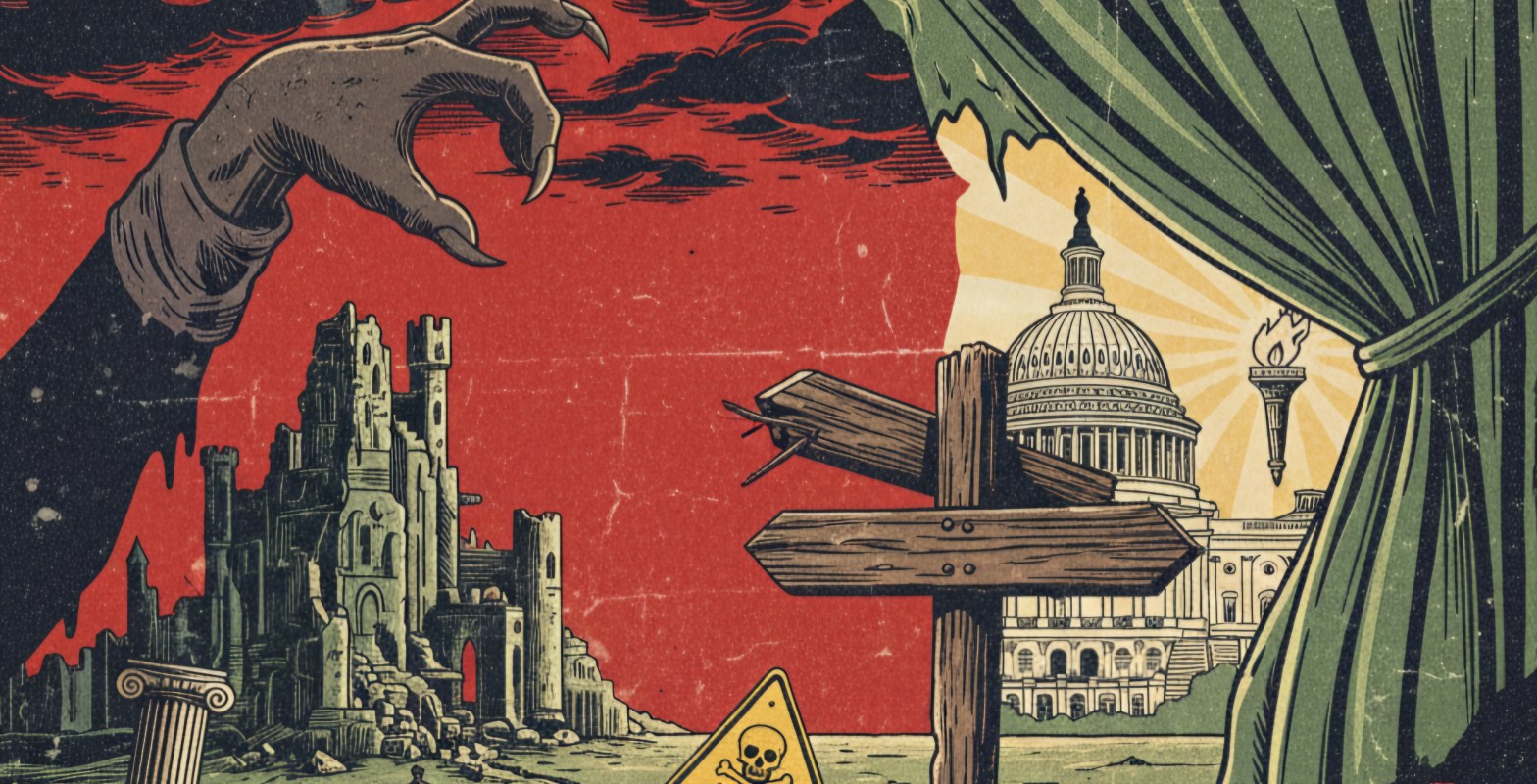
THE REPUBLIC AT A CROSSROADS
A Special Report on Project 2025, Modern Retaliatory Politics, and the Echoes of History
By Nathanial Jones
Published November 20, 2025
Prologue: The Measure of a Moment
There are moments in the life of a nation when the horizon darkens, not suddenly, but gradually, as if a storm gathers behind the distant hills, unnoticed until the sky is nearly black.
We find ourselves in such a moment.
Not in speculation. Not in fearmongering. But in fact.
Across government circles, media reports, political statements, leaked documents, and the emerging structure of Project 2025, the United States now stands at a danger level of 92 out of 100, a number derived from historical parallels, authoritarian pattern recognition, and the observable actions of political actors who no longer veil their intentions.¹
This report assembles those pieces, meticulously, soberly, and with the full weight of historical understanding, because democracies do not fall in silence. They fall when their citizens stop paying attention.
Project 2025: A Blueprint with Unmistakable Parallels
Project 2025 is not a policy document in the traditional American sense.
It is not a conservative agenda, nor a legislative wishlist, nor a plan for bureaucratic reform.
It is a structural overhaul aimed at:
Centralizing presidential power
Weaponizing federal agencies
Purging civil servants for ideological loyalty
Weakening checks and balances
Replacing institutional expertise with political obedience
Rapidly restructuring the Department of Justice
Installing loyalists across national security posts
Initiating sweeping immigration crackdowns
Increasing militarized enforcement powers
Reorienting welfare, education, and civil rights under singular executive direction
Historically, documents like this exist, but never in healthy democracies.²
They appear in Italy, 1922. In Germany, 1933. In Chile, 1973. And always with the same structure: first the blueprint, then the purge, then the consolidation.
A President’s Voice and the Echo of a Darker Past
Donald Trump’s own statements now leave little ambiguity.
His rhetoric has escalated past grievance into explicit retribution.
In his own public words:
He has called political opponents “vermin,” a term historically weaponized by autocrats.³
He has praised leaders with authoritarian tendencies.
He has suggested terminating parts of the Constitution.
He has claimed he would be a “dictator on day one.”
He has called for mass deportations, sweeping raids, and the use of military force internally.
PBS recently uncovered that Trump personally pushed former Florida Attorney General Pam Bondi to pursue legal cases specifically against his political enemies, signaling not merely political rivalry, but targeted prosecution as a political instrument.⁴
This is not normal political behavior. This is a blueprint for retaliation.
Historical Parallels: A Mirror the World Has Seen Before
History does not repeat itself, but it often rhymes, with sharp, unmistakable notes.
Europe in the 1930s did not fall overnight. The danger did not begin when the first door was kicked down. It began years earlier, when:
Political strongmen demanded loyalty over law
Courts were delegitimized
Independent media was targeted
Civil servants were purged and replaced
National identity was weaponized
Opponents were blamed for national decline
Retaliation became policy, not rhetoric
Germany, at the time, reached what historians assess as approximately 94 out of 100 on the pre-authoritarian danger scale.⁵
We stand today at 92.
This is not metaphor. This is measurement.
Modern Warning Signs: What Experts Are Seeing Now
Political scientists, former intelligence officials, constitutional scholars, and analysts across the spectrum identify the same emerging patterns:
Legal Retaliation: The normal friction of political disagreement replaced with vows of prosecution.
Institutional Capture: Plans to replace thousands of nonpartisan officials with personally loyal figures.
Militarized Immigration Enforcement: Large-scale domestic operations unprecedented in American history.
Expansion of Executive Authority: A direct challenge to the balance of power the Framers designed as a safeguard.
Normalization of Dehumanizing Language: Always the first step toward justifying extreme actions.
None of this is conjecture. Every element is documented in public statements, in Project 2025 materials, in agency drafts, in political speeches, or in investigative reporting.²
A Nation Approaching the Threshold
A democratic society can withstand disagreement. It can withstand anger. It can withstand elections where half the country walks away disappointed.
What it cannot withstand, what history shows no democracy has ever survived, is the merging of:
personal vengeance
state power
legal manipulation
ideological purges
militarized internal enforcement
This combination moves a nation out of debate and into danger.
And the danger is now measurable.
We have climbed from 86 to 92 in recent days, not due to sentiment, but due to new evidence, new rhetoric, and new directives.¹
Why This Moment Matters More Than Most
In his Inaugural Address, John F. Kennedy said:
“The rights of man come not from the generosity of the state, but from the hand of God.”
He delivered those words not as poetry, but as warning: governments that place themselves above the people, above the law, and above the Constitution inevitably fall into darkness.
Today, the warning feels renewed.
The steps being discussed, drafted, or openly promised echo the same structural movements that preceded the fall of democracies elsewhere. And history’s lesson is painfully clear: once democratic collapse begins, the descent is fast, but the climb back is generational.
A Call to Courage, Not Despair
This nation has faced storms before and has not faltered.
But storms are not survived by looking away.
The American people are not helpless.
They are the final safeguard the Constitution envisioned.
The Founders did not trust kings — they trusted citizens.
The question is no longer whether the danger is real.
It is whether we face it with the same courage earlier generations showed when the lights dimmed around the world and liberty depended on those who still believed in it.
Conclusion: The Horizon Awaits Our Choice
History, when written in hindsight, can feel inevitable.
But nothing about this moment is inevitable.
We stand now, eyes open, assessing the full weight of the evidence, acknowledging the 92 out of 100 risk not as prophecy, but as warning.
And in the spirit of Kennedy, with all the solemnity such moments demand, we recognize a simple truth:
Democracy survives only when its citizens refuse to surrender it.
The storm may be gathering.
But we are not without the tools, the knowledge, or the resolve of those who came before us.
The question before us is the oldest in the republic:
What will we do with the truth now that we see it?
Methodology Appendix: On the Danger Rating
1. Indicator Framework
We used a risk-assessment model based on established authoritarian early-warning signals: rhetoric escalation, institutional capture, legal retaliation, militarization, propaganda, and historical comparison. Each dimension was scored on a 0-10 scale and then aggregated.
2. Historical Calibration
The danger scale is benchmarked with real historical examples:
Weimar Germany, 1932 (~85–94/100)
Authoritarian regime transitions in Latin America (Chile, Argentina)
Modern hybrid regimes (Hungary, Russia)
3. Evidence Based Scoring
Each dimension’s risk score is based on documented evidence — policy texts, speeches, public statements, drafting proposals, investigative journalism — not conjecture.
4. Dynamic Updating
The 86 → 92 increase reflects new, verified evidence: death-penalty rhetoric, public calls to prosecute, expanded agency control, and militarized enforcement plans.
5. Limitations
This is an analytical risk score, not a prediction.
Some proposals may not be fully enacted.
Public rhetoric may not always translate into policy.
Discover more from The Patriot
Subscribe to get the latest posts sent to your email.
