Washington’s Enduring Warnings: A Look at Extremism, National Unity, and the Republic’s Early Divides
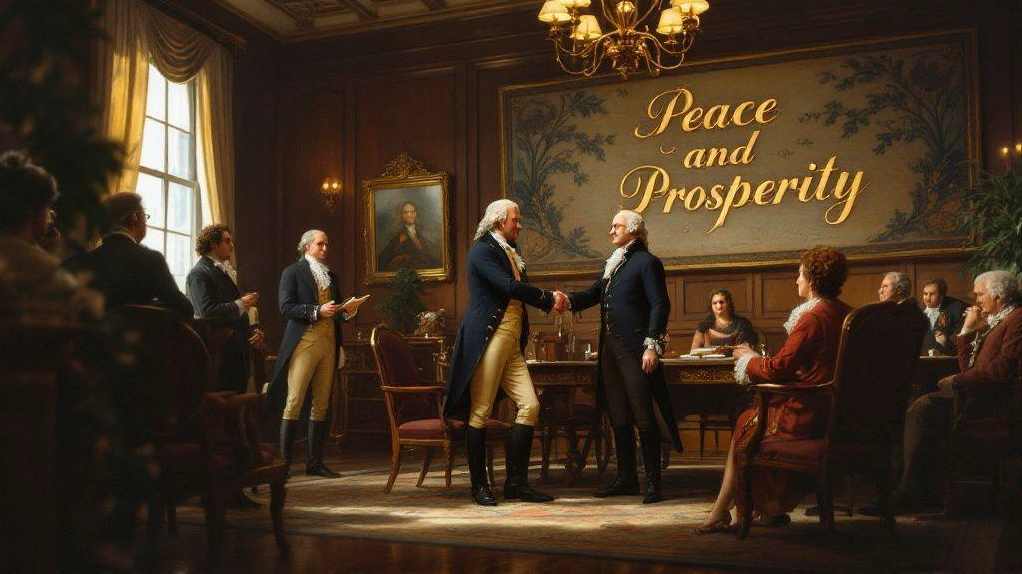
George Washington, the first president of the United States, left behind a legacy that extends beyond his military victories and presidential precedents. His words, particularly those in his Farewell Address, remain a crucial guide, offering insights into the dangers of political extremism and the paramount importance of national unity. This guidance is particularly salient when examined against the backdrop of the republic’s formative ideological battles, which threatened to fracture the fledgling nation.
Washington’s era, much like our own, was characterized by profound political divisions. The nascent republic grappled with fundamental questions about its identity, its governance, and its economic direction. Washington, acutely aware of the fragility of the nation, recognized the inherent danger of these divisions escalating into irreconcilable conflicts. He was a keen observer of the “spirit of party” and its potential to undermine the common good, a phenomenon he witnessed firsthand.
The Perils of Extremism and Factionalism:
Washington’s most pointed warnings centered on the dangers of factionalism and the “spirit of party.“ He observed that “the alternate domination of one faction over another, sharpened by the spirit of revenge, natural to party dissension, which in different ages and countries has perpetrated the most horrid enormities, is itself a frightful despotism.” He understood that unchecked partisanship could lead to a destructive cycle of retribution, ultimately eroding the foundations of the republic and jeopardizing its very existence.
His concerns resonate deeply with contemporary discussions about political polarization and the rise of extreme ideologies. Whether emanating from the far left or the far right, these extremes share a common thread: a willingness to prioritize ideological purity over reasoned discourse, compromise, and the pursuit of the common good.
- Far-Left Extremism: Characterized by radical calls for economic and social transformation, it can lead to authoritarian tendencies in the pursuit of perceived equality, often suppressing individual liberties in the name of a collective ideal.
- Far-Right Extremism: Rooted in nationalism, traditionalism, and often exclusionary identities, it can manifest as discriminatory policies, the suppression of dissent, and even violence against perceived enemies of the nation.
Both extremes pose a significant threat to democratic institutions, the rule of law, and the fundamental rights of citizens.
The Importance of National Unity, Amidst Early Divides and Struggles:
Washington believed that national unity was paramount to the survival of the republic. He emphasized that “the unity of government which constitutes you one people is also now dear to you.” He understood that a shared sense of national identity and purpose was essential to overcome the inevitable divisions that arise in a free society. However, achieving this unity was a constant struggle, particularly in the early years of the republic.
These divisions were particularly pronounced in the clash between the Federalists, led by Alexander Hamilton, and the Democratic-Republicans, led by Thomas Jefferson.
- Economic Visions and the National Bank: The Federalists favored a strong central government, a national bank to stabilize the economy, and a diversified economy including manufacturing and trade. The Democratic-Republicans, conversely, advocated for a limited federal government, an agrarian economy, and states’ rights. The creation of the First Bank of the United States became a major point of contention, with Democratic-Republicans fearing it would concentrate power in the hands of the wealthy elite.
- Constitutional Interpretation: Disagreements over the interpretation of the Constitution further exacerbated tensions. Federalists favored a “loose construction,” arguing that the government had implied powers beyond those explicitly stated in the document. Democratic-Republicans, on the other hand, adhered to a “strict construction,” emphasizing that the government’s powers were limited to those explicitly granted.
- Foreign Policy and the French Revolution: The French Revolution and the subsequent war between France and Britain deeply divided the nation. Federalists tended to favor Britain, emphasizing commercial ties and stability, while Democratic-Republicans sympathized with France, seeing it as an extension of the American Revolution. This division led to debates about neutrality and the nation’s obligations to its former ally.
- The Whiskey Rebellion: This uprising, sparked by opposition to a federal excise tax on whiskey, highlighted the tensions between the federal government and western farmers. Washington’s decisive response, leading the military to suppress the rebellion, demonstrated his commitment to upholding federal law and authority, but it also underscored the deep-seated grievances that existed within the nation.
- The Alien and Sedition Acts: Passed during the Adams administration, these acts, supported by Federalists, aimed to suppress dissent and criticism of the government. Democratic-Republicans vehemently opposed them, arguing that they violated the First Amendment. This conflict further deepened the partisan divide.
While Washington’s influence helped to maintain a semblance of unity during his presidency, the underlying divisions persisted. The rise of partisan newspapers, the formation of political organizations, and the increasingly heated rhetoric of political debates all contributed to a growing sense of polarization.
Washington’s Legacy and Enduring Relevance:
Washington’s approach to combating extremism and fostering national unity was multifaceted:
- Leading by Example: His voluntary resignation as Commander-in-Chief and his decision to step down after two terms as president set crucial precedents for civilian control of the military and the peaceful transfer of power.
- Promoting Civic Virtue: He emphasized the importance of moderation, self-restraint, and a commitment to the common good.
- Upholding the Rule of Law: He believed that a stable republic depended on adherence to legal processes and constitutional principles.
- Communicating his Principles: His Farewell Address stands as a testament to his ability to articulate his political philosophy and warn against the dangers of extremism.
His words and actions serve as a reminder that the preservation of democracy requires constant vigilance, moderation, and a commitment to national unity. As Washington himself stated, “Citizens by birth or choice, of a common country, that country has a right to concentrate your affections.” While some of the partisan feelings were reduced after the election of Jefferson, the underlying issues continued to be a part of the American political landscape, and still are.
By understanding Washington’s concerns, embracing his principles, and learning from the struggles of the early republic, we can strive to navigate the challenges of our own time and safeguard the enduring glory of the American vision.

Discover more from The Patriot
Subscribe to get the latest posts sent to your email.
